Littelfuse has introduced two new magnetic angle sensors, the LF3466 and LF53464, based on tunnel magnetoresistance (TMR) technology. These magnetic sensors provide highly accurate 0-360° angle measurement with minimal thermal drift in harsh environments.
As a diversified industrial technology manufacturer, Littelfuse is committed to powering a sustainable, connected, and safer world. Both new sensors utilize TMR technology and a dual push-pull Wheatstone bridge configuration, with four highly sensitive sensing elements, for precise angle detection along the X and Y axes. These TMR angle sensors offer excellent thermal stability, wide supply voltage compatibility, and enhanced measurement accuracy.
About LF3466 and LF53464
The LF53466, housed in a standard TSSOP8 package, provides precision angle sensing with an error of less than 0.8° across a magnetic field range of 200-800 Gs. This product is ideal for industrial and automotive applications requiring robust and easily inspectable mechanical solder joints, such as steering wheel angle sensors, pedal position sensors, and contactless potentiometers.
The LF53464 with a compact LGA8L package achieves even greater accuracy, achieving an angular error below 0.6°, and a longer sensing distance, enabling compatibility with smaller, lower-cost magnets. It is also well-suited for space-constrained applications such as rotary encoders, knob and valve position sensing, and consumer devices, including power tools and appliances.
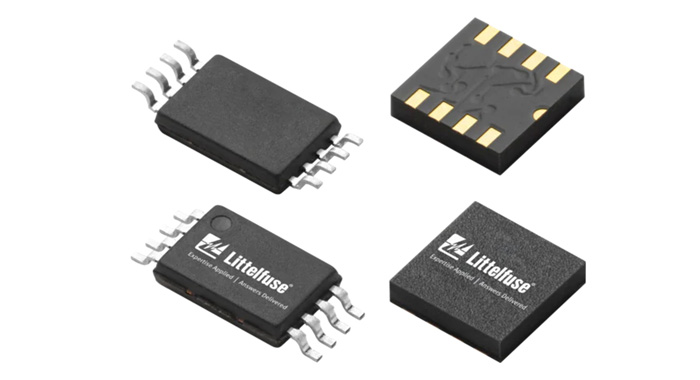
Source from Internet
TMR sensors utilize the tunneling magnetoresistance effect. Their core structure consists of two layers of ferromagnetic material sandwiched by an extremely thin and nanoscale insulating barrier. Simply put, the tunneling probability of electrons changes with the relative magnetization orientation of the two layers, resulting in a dramatic change in resistance.
Therefore, the LF3466 and LF53464 are compelling alternatives to Hall-effect devices. Their advantages include:
Significantly improved accuracy and sensitivity: They offer higher zero-value and lower angular error, which are critical for high-precision industrial automation and precision motor control.
Superior thermal stability: While the output of Hall-effect devices is susceptible to temperature fluctuations, Littelfuse's TMR sensors feature a built-in, superior thermal drift compensation mechanism, ensuring stable performance in harsh ambient temperatures and providing more reliable readings.
More flexible packaging and air gap design: The LF53464's compact LGA8L package supports a larger sensing air gap (the allowable distance between the sensor and the magnet). This allows engineers to design with wider tolerances and even utilize smaller, lower-cost magnets.
Differential Output Improves Interference Immunity: They provide differential outputs that effectively suppress common-mode noise, ensuring signal integrity and reliability in complex electromagnetic environments.
"These new TMR omnipolar sensors significantly expand the Littelfuse magnetic sensing portfolio by opening the door to a wider range of industrial, mobile, and consumer markets," said Julius Venckus, Global Product Manager, Sensors. "The LF53466 and LF53464 combine high accuracy, thermal stability, and packaging flexibility to enhance applications requiring speed control and angle detection."
Target Markets and Applications
Industrial Automation and Robotics: Rotary position sensors, absolute angle detection, and robotic arm or joystick control for factory equipment and smart machinery.
Motor and Off-Highway Vehicles: Steering angle, pedal position, and motor control for e-bikes, two- and three-wheeled vehicles, and electric construction or off-road vehicles.
Consumer and Smart Devices: Compact sensing in power tools, smart thermostats, and appliances, including knob and valve position sensing, for intuitive user interfaces.
Precision Control Systems: High-resolution rotary encoders, contactless potentiometers, and angle sensors for motor feedback, valve actuation, and HMI (human-machine interface) applications.