In embedded systems applications such as industrial control and intelligent devices, processors are facing stringent challenges in terms of computing power, peripheral compatibility, and stability. NXP's MC56F81xxx series of digital signal controllers (DSCs) combines the high-speed computing of a DSP, the flexible control of an MCU, and a wealth of peripherals. With its powerful 32-bit 56800EX core and excellent adaptability, that ideal for embedded designs in various scenarios.
Core Architecture: The Cornerstone of Performance and Efficiency
The core competitiveness of the MC56F81xxx series chips lies in its 32-bit 56800EX core. Through a modified Harvard architecture, it integrates three address buses and four data buses, enabling parallel instruction loading and synchronous data access. Its 162 basic instruction set fully supports fractional and integer arithmetic, laying a solid foundation for executing complex control algorithms.
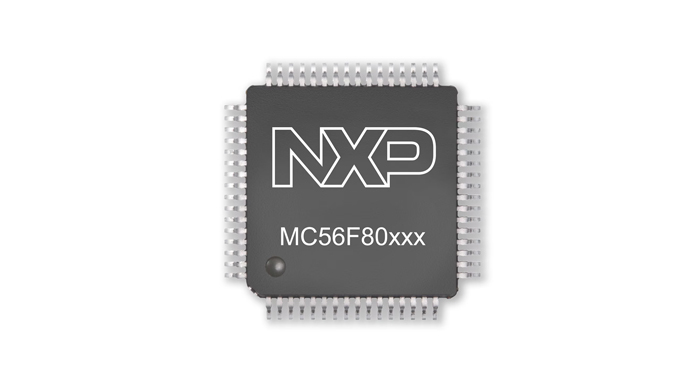
In terms of performance, this integrated circuit can reach a core frequency of 100MHz in fast mode and provide a powerful computing power of 100 MIPS. Combined with 16×16-bit and 32×32-bit multiplication and accumulation operations completed in a single cycle, it can respond extremely quickly to real-time signal processing tasks such as filtering and modulation. Furthermore, it has a highly flexible memory system, supporting up to 128KB of flash memory and 20KB of RAM, which can be freely mapped to program or data space. Combined with a Boot ROM supporting multiple boot modes, it meets diverse development needs.
Key Peripherals: The Engine Driving Precise Control
1. High-Precision Analog Subsystem
The chip integrates two high-speed 12-bit ADC modules, equipped with programmable gain amplifiers up to 4x and sampling clocks up to 12.5MHz. This module supports multiple input modes, including single-ended and differential, enabling precise capture of weak signals from industrial sensors or medical devices. Simultaneously, integrated operational amplifiers, a 12-bit DAC, and multiplexed analog comparators constitute a complete signal chain solution, significantly reducing the number of external components.
2. High-Resolution PWM and Timing System
Its enhanced eFlexPWM module provides up to 12 PWM outputs. Some channels utilize NanoEdge technology, achieving picosecond-level resolution and supporting dead-time insertion and complementary output, perfectly suited for applications with stringent timing accuracy requirements, such as motor drives and digital power supplies. Abundant timer resources, such as periodic interrupt timers and quadrature decoders, further expand its capabilities in position detection and speed measurement scenarios.
3. Comprehensive Communication and Security Assurance
Communication interfaces cover queued SCI, SPI, and an I2C module supporting PMBus, easily handling multi-master communication or LIN bus applications. In terms of security, the chip's built-in CRC check module, watchdog, and external watchdog monitor together construct a robust data and program security defense, ensuring long-term stable operation of the system in complex industrial environments.
4. Wide Environmental Adaptability
The chip supports a wide power supply voltage from 2.7V to 3.6V and offers extended temperature range options from -40℃ to 105℃/125℃, easily handling harsh conditions such as extreme outdoor cold or industrial high temperatures. It also provides multiple package options from 32-pin to 64-pin, facilitating compact device designs.
Typical Application Scenarios
Thanks to its balanced performance and integration, the MC56F81xxx series has become an ideal control core for multiple fields:
High-performance industrial control: such as servo drives and robotic arms, achieves precise motion and torque control.
Smart home appliances: serving as the "brain" of inverter air conditioners and washing machines, achieving energy saving, noise reduction, and intelligent control.
Energy and power: widely used in solar inverters and UPS power supplies to improve energy conversion efficiency.
Medical and security: meeting the high requirements of patient monitors and fire alarm systems for signal acquisition accuracy and operational reliability.
Design Optimization: The Key to Unleashing the Chip's Full Potential
To ensure optimal system performance, hardware design should focus on the following three aspects:
Power Integrity: The voltage difference between analog and digital power supplies should be controlled within 0.1V, and decoupling capacitors should be placed near each power pin, with a total capacitance value recommended to be in the range of 4.0-5.0μF.
Thermal Management: A 4-layer or higher PCB design is recommended to optimize heat dissipation paths. For example, a 64-pin LQFP package can effectively reduce the junction-to-ambient thermal resistance to approximately 52°C/W.
Interference Immunity Design: Analog and digital signal traces should be physically isolated, and RC filters should be added to the ADC input channel. All unused pins should be properly disposed of to improve system electromagnetic compatibility.
Conclusion
In summary, the MC56F81xxx series DSC successfully breaks down the traditional boundaries between DSPs and MCUs, providing a highly competitive single-chip solution in the embedded control field through its triple advantages of "powerful computing power, flexible peripherals, and superior reliability." Whether processing complex algorithms or driving multiple peripherals, it can handle the core control role in various demanding applications.