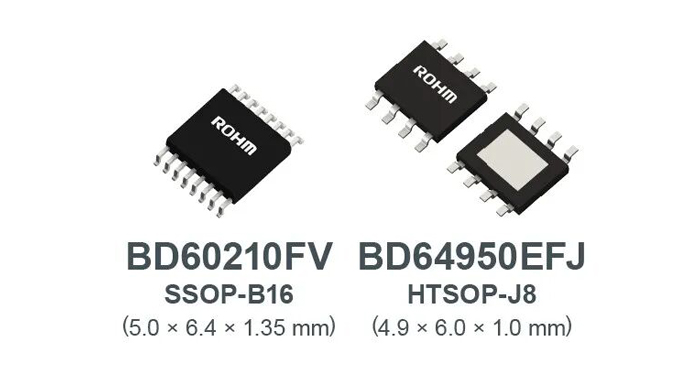
In the evolving landscape of electronics, from everyday consumer appliances to sophisticated industrial machinery, the push for greater efficiency, miniaturization, and design simplicity is relentless. A key component in this movement is the motor driver IC, the crucial interface between a microcontroller and the motors that perform physical work. Recognizing the growing demands for standardized, compact, and highly reliable motor control solutions, leading semiconductor manufacturer ROHM has introduced two new general-purpose brushed DC motor driver ICs: the BD60210FV and the BD64950EFJ. These products are engineered to address the challenges faced by designers.
The Market Need: Balancing Performance, Cost, and Design Efficiency
The electrification of control mechanisms is accelerating across various sectors. In refrigerators and air conditioners, as well as in industrial equipment such as automated doors and conveyor belts, brushed DC motors remain popular due to their cost-effectiveness and simplicity. However, market trends demand that these motors be controlled more efficiently.
Key Requirements
Design Standardization: Reducing development time for product variants.
Component Count Reduction: Simplifying PCB layout, lowering BOM costs, and enhancing reliability.
Space Saving: Accommodating more features in increasingly compact form factors.
High Reliability: Ensuring robust operation over the product's lifetime.
ROHM's new BD60210FV and BD64950EFJ are direct responses to these challenges, offering an optimal blend of versatility, space-saving characteristics, and design-friendly features to improve both the performance and development efficiency of end products.
Product Highlights: BD60210FV and BD64950EFJ
Both new ICs leverage universally compatible package formats, making them easy to introduce into new designs. This significantly enhances efficiency during circuit modifications, the development of derivative models, and design standardization efforts. A standout feature common to both drivers is an exceptionally low standby current (Typ: 0.0μA, Max: 1.0μA), which dramatically improves the energy-saving performance of the end product during idle periods.
Source from Internet
Let's examine the unique capabilities of each driver:
1. BD60210FV: Dual-Channel Driver for Maximum Flexibility
The BD60210FV is a dual-channel (2ch) H-bridge motor driver capable of driving two independent brushed DC motors or a single stepper motor. It utilizes a Direct PWM control method.
Key Advantages
Reduced External Components: By employing an H-bridge circuit structure that requires no external charge pump or voltage booster, the BD60210FV minimizes the number of external components needed. This leads to significant space savings on the PCB and simplifies the overall design process.
Design Simplicity: The direct PWM control interface is straightforward, allowing motor speed to be controlled directly by the PWM signal's duty cycle from the microcontroller, resulting in fast response times.
Voltage Rating: 20V absolute maximum voltage, suitable for a wide range of low-voltage applications.
This driver is ideal for applications that require the coordinated control of multiple small motors or precise stepper motor movement.
2. BD64950EFJ: High-Voltage, High-Efficiency Single-Channel Driver
The BD64950EFJ is a robust single-channel (1ch) H-bridge driver designed for more demanding applications. It stands out with its higher voltage tolerance and support for multiple control modes.
Key Advantages
High Voltage Rating: With a 40V absolute maximum voltage, it is perfectly suited for systems that use 24V power rails, commonly found in industrial equipment.
Dual Control Modes: It supports both Direct PWM control and Constant Current PWM control. The constant current mode is particularly beneficial for applications requiring maintained torque at low speeds and more precise control, as it regulates the current supplied to the motor.
Low On-Resistance: The IC features Low on-resistance (Rds(on)), which minimizes power loss and heat generation during operation. This translates to higher driving efficiency and reduces the need for extensive thermal management.
This combination of features makes the BD64950EFJ a powerful solution for reliably and efficiently driving larger brushed DC motors.
Application Examples
These motor drivers are versatile enough for a broad spectrum of applications, including consumer electronics, industrial equipment, and various other small motor control systems.
Consumer Electronics
Refrigerators: Ice maker rotation, damper control.
Air Conditioners: Louver (air vent) control.
Printers: Guide rail movement.
Robot Vacuums: Brush head rotation.
Water Heaters & Rice Cookers: Valve control.
Humidifiers: Fan speed control.
Industrial Equipment
Automated Doors & Shutters: Motion control.
Small Conveyor Belts: Transport control.
Power Tools: Rotation control.
Availability and Support
To accelerate the design process, both the BD60210FV and BD64950EFJ are now in mass production. Samples are available for purchase through major distributors. Furthermore, ROHM offers dedicated evaluation boards:
BD60210FV-EVK-001 for the BD60210FV
BD64950EFJ-EVK-001 for the BD64950EFJ
These boards provide engineers with a ready-to-use platform for testing and prototyping, significantly shortening the development cycle.
Conclusion
ROHM's latest motor driver ICs, the BD60210FV and BD64950EFJ, provide compelling solutions for designers seeking to optimize their brushed DC motor control systems. By addressing critical needs for component reduction, design simplification, high efficiency, and low standby power, these drivers enable the creation of more advanced, compact, and energy-conscious products. As ROHM continues to expand its portfolio of motor drive solutions, it reaffirms its commitment to contributing to a more comfortable and energy-efficient society.
Terminology Explained
H-bridge: An electronic circuit that enables control over the direction of rotation of a DC motor. It is named for its schematic diagram, where four switches (transistors or MOSFETs) are arranged in an "H" pattern.
Direct PWM Control: A method where a Pulse Width Modulation (PWM) signal is applied directly to the H-bridge to control the motor's speed. The average voltage supplied to the motor is adjusted by varying the duty cycle of the PWM signal. This offers a relatively simple circuit structure and fast response.
Constant Current PWM Control: A control method that uses PWM to maintain a constant current through the motor. This is useful for maintaining torque at low speeds and is suitable for applications requiring precise control, such as in specialized industrial equipment.