The rapid adoption of AI, from data centers to edge devices, is reshaping the memory industry. While high-bandwidth memory (HBM) and DDR5 dominate headlines for cloud applications, edge AI demands a different approach: balancing high bandwidth, low power, and cost efficiency. At a recent joint technology forum with NXP in Shenzhen, Winbond Electronics, a global leader in specialty memory, unveiled its strategy to address this gap through customized solutions tailored for edge computing's unique challenges.
Niche Focus: Customized Memory for a Disaggregated Market
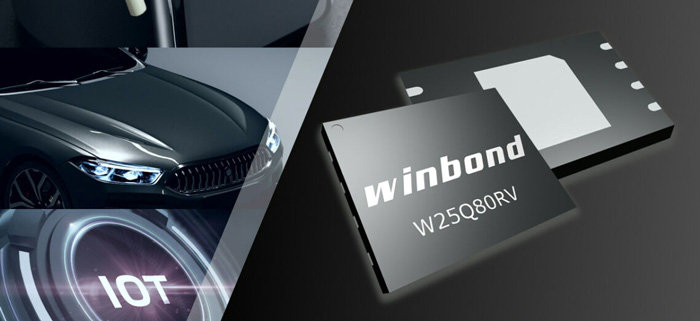
Winbond distinguishes itself by concentrating on mid- to low-capacity specialty memory ICs, avoiding direct competition with giants like Samsung and Micron in high-capacity segments. Instead, it offers a dual portfolio: standardized DDR3/DDR4 and LPDDR4 for legacy systems, and semi-custom products such as CUBE and HyperRAM for edge AI. This bifurcation reflects a structural shift in the memory market. As major manufacturers pivot to HBM and DDR5 for AI servers, which results in a shortage of supply for DDR4/LPDDR4, creating opportunities for Winbond to serve industrial, automotive, and IoT customers who still rely on these technologies.
Source from the Internet
The company's Customized Memory Solutions (CMS) division rebrands DRAM offerings to emphasize flexibility. For instance, CUBE combines high I/O counts (up to 1,024 channels) with advanced 2.5D/3D packaging to deliver bandwidths rivaling HBM but at lower power—critical for battery-powered devices like AI glasses or collaborative robots. Meanwhile, Winbond's NOR Flash and SLC NAND focus on code storage, where reliability matters more than sheer capacity. The company leads globally in NOR Flash market share and prioritizes mature, stable processes over chasing the highest densities.
Engineering Breakthroughs: Overcoming the Power-Performance Trade-Off
Winbond's core innovation lies in decoupling bandwidth from power consumption. Traditional DRAM scales bandwidth by increasing frequency, which escalates power draw. In contrast, CUBE uses massive I/O parallelism—akin to adding lanes to a highway—to boost data throughput without raising clock speeds. This allows bandwidths exceeding 1 TB/s while consuming under 1 pJ/bit, a fraction of HBM's energy footprint.
Thermal management is another key advantage. CUBE's design places the SoC above the memory die, directing heat toward a heatsink while leveraging through-silicon vias (TSVs) for efficient signal routing. This avoids costly TSVs in the logic die, reducing complexity. Winbond's IDM (integrated device manufacturer) model, with two 12-inch wafer fabs, enables tight control over process nodes. Its DRAM has advanced to 16 nm, while NOR Flash and SLC NAND are mass-produced at 45 nm and 24 nm, respectively, enhancing bit density without expanding production capacity.
Market Dynamics: Structural Scarcity and Long-Term Opportunities
The AI boom has triggered a supply crunch for older-generation memories. As top players reallocate wafer capacity to HBM and DDR5, DDR4/LPDDR4 production has plummeted. Winbond estimates that major suppliers have halved DDR4 output, with further cuts expected. This scarcity is structural: fabs converted to newer nodes cannot easily revert, leaving a persistent gap for mid-capacity memory. While prices have surged, Winbond sees this as a chance to deepen relationships with clients in automotive and industrial sectors, where long product lifecycles discourage rapid migration to DDR5.
To address the shortage, Winbond plans an NT$40 billion expansion focused on DDR4/LPDDR4 capacity. Simultaneously, it continues evolving its 16 nm DRAM technology, with 8 Gb LPDDR4 already shipping at scale and 16 Gb DDR4 samples underway.
Security and Sustainability: Embedded Protection for Connected Devices
Beyond performance, Winbond's TrustME® Secure Flash addresses critical safety needs in automotive and IoT systems. Complying with standards like ISO 21434 and ASIL-D, it offers hardware-rooted features such as anti-tampering and secure boot. With regulations like the EU's RED directive mandating security for wireless devices, TrustME enables clients to retrofit protection without hardware changes.
Conclusion
Winbond's edge-AI strategy exemplifies how specialization trumps scale in fragmented markets. By coupling custom engineering with operational agility, it turns industry disruptions into opportunities. As AI workloads proliferate at the edge, Winbond's ability to deliver high bandwidth, ultra-low power, and scalable security will make it an indispensable partner for innovators seeking to push intelligence closer to the source.